
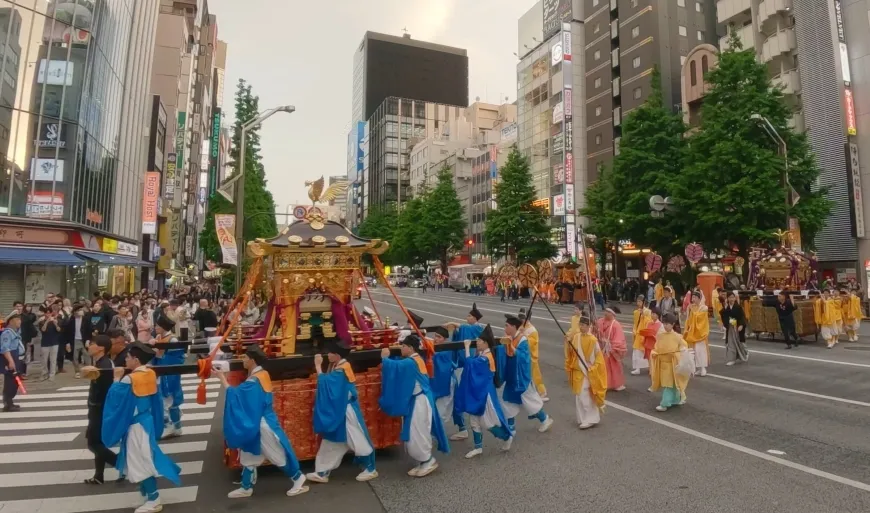
The Kanda Festival in Tokyo is one of Japan’s three major festivals.
In 2025, it is scheduled to take place in mid-May at the Kanda Myojin Shrine close to Akihabara, with the main parade occurring on May 10. Discover the festival’s key features, parades, and information on how to reach the location.
Kanda Matsuri: One of the Three Major Shrine Festivals in Japan
The Kanda Festival takes place at Kanda Myojin Shrine, situated near Tokyo’s Akihabara area. It is regarded as one of Japan’s three major festivals, alongside Kyoto’s Gion Festival and Osaka’s Tenjin Festival.
The Kanda Festival features two primary events: the Main Festival (Hon-matsuri), which occurs in odd-numbered years, and the Shadow Festival (In-matsuri), which takes place in even-numbered years. Generally, when people mention the Kanda Festival, they are referring to the vibrant Main Festival.
In 2025, the Kanda Matsuri Festival is scheduled to run from May 8 to May 15, with the main procession (Shinkosai) taking place on May 10. This procession will travel through central Tokyo districts, including Kanda, Nihonbashi, Otemachi, Marunouchi, and Akihabara.
The Historical Background of the Kanda Masturi
Few records remain of the beginning of the Kanda Festival, and the details are not clear, but it is believed that it did not take form as a major festival until the Edo period (1603-1868).
In the “Kanda-Daimyojin Goyousho” written in the Edo period, it is mentioned that Ieyasu Tokugawa prayed to Kanda-Daimyojin in 1600 in preparation for his battle against Kagakatsu Uesugi. He also prayed for the same victory during the Battle of Sekigahara.
As a result, prayers were routinely offered at Kanda Myojin under the direction of Ieyasu. In particular, Ieyasu’s victory in the battle on September 15, the day of the festival, and his unification of the country led to Kanda Myojin’s designation as the head deity of Edo.
Tokugawa Ieyasu developed a special devotion to Kanda Myojin and donated shrine buildings, portable shrines, and ritual utensils.
Initially, the Kanda Myojin Festival was centered around dashi (floats) and hikimono (floats), but over time, it shifted to a form centered around the portable shrine.
By the mid-Edo period, gorgeous and gorgeous portable shrines and floats began to compete with each other, gaining the enthusiastic support of the general public and becoming one of the representative festivals of Edo (present-day Tokyo).
After the Meiji period (1868-1912), the festival had to be temporarily suspended or reduced in scale due to the *Tokyo Tento and World War II, but it was restored thanks to the enthusiasm of the shrine parishioners and local people.
*Tokyo Tento: This refers to the event in which Edo was renamed Tokyo and became the capital of Japan.
In addition to traditional Shinto rituals and portable shrine processions, modern Kanda Matsuri incorporates new elements in keeping with the times. For example, the Tsuke Matsuri, or tsuke-matsuri, features an elaborate procession that reflects the year’s social climate, delighting many onlookers.
In recent years, the Honsai (the festival in which a large portable shrine procession takes place, in odd-numbered years) and the Yin Matsuri (the festival in which the focus is on Shinto rituals, in even-numbered years) have been held every other year, providing opportunities for more people to become involved in the Kanda Matsuri.
The Yin Matsuri is the only annual festival held on the grounds of Kanda Myojin in even-numbered years.
Dates, Schedule of Kanda Matsuri Festival
| May 8 | 19:00 | Horen-Mikoshi-Senza-sai |
| May 9 | 14:00~ | Ujikochokai-Mikoshi-Shinrei-ire |
| May 10 | Whole Day | Shinko-Sai(parade through Kanda, Nihonbashi, Otemachi, Marunouchi, Akihabara) |
| May 10 | 15:00~ | Tsuke-Matsuri |
| May 10 | Whole Day | Shinko-Sai-Mikoshi-Miya-Iri |
| May 11 | Whole Day | Mikoshi-Miya-Iri |
| May 14 | 11:00 | Kencha-Kai |
| May 14 | 17:30開場 | Myojin-Nou & Yugen-no-Hana |
| May 15 | 14:00 | Reitai-Sai |
Experiencing the Essence of Kanda Matsuri
Among the many other rituals of the Kanda Matsuri,
- Shinko-Sai
- Mikoshi-Miyairi
- Reitai-Sai
are the three indispensable pillars that demonstrate the multifaceted charm of the Kanda Matsuri. From the solemn procession of the Shinkosai to the exhilarating energy of the Mikoshi Miyairi and the solemn reverence of the En-taisai, each event is a unique and unforgettable glimpse into the heart of this great festival. Together, these events create a rich tapestry of Kanda Matsuri tradition, community spirit, and religious devotion that continues to captivate and inspire all who experience the vibrant energy of the Kanda Matsuri.
Highlights of the Kanda Matsuri
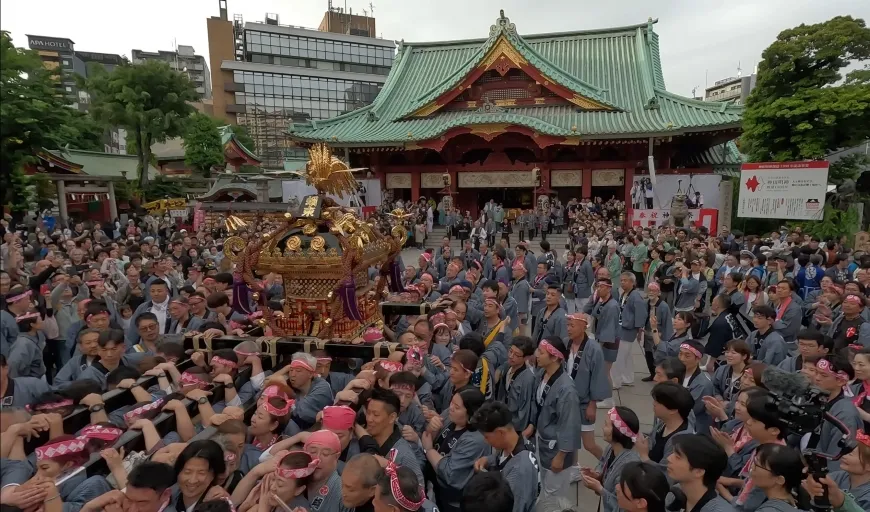
Shinko-Sai Procession arriving to Kanda Shrine
The Shinko-Sai Procession
The Shinkosai, often considered the centerpiece of the Kanda Matsuri, is a day-long procession that embodies the festival’s historical significance. Held on the Saturday of the main festival weekend, this elaborate parade sees the mikoshi (portable shrines) of Kanda Myojin’s three main deities – Daikokuten, Ebisu, and Taira no Masakado are carried through the bustling heart of Tokyo.
These ornately decorated mikoshi, resplendent with intricate carvings, gleaming gold leaf, and vibrant tassels, are not merely objects; they are believed to temporarily house the spirits of the deities. As such, their journey through the city is a sacred act, blessing the businesses and residents along the way with prosperity and good fortune.
The procession is a visual feast, stretching for kilometers and involving hundreds of participants dressed in traditional attire. Leading the way are priests in ceremonial robes, followed by musicians playing traditional drums and flutes, and then the energetic bearers who shoulder the heavy mikoshi. The rhythmic chanting of “Wasshoi! Wasshoi!” fills the air as the bearers sway and surge, creating a wave of dynamic energy that electrifies the crowds lining the streets.
The Shinkosai is more than just a parade, it’s a living tapestry of tradition, community spirit, and religious devotion. Witnessing the majestic mikoshi making their way through the modern cityscape offers a powerful contrast and a tangible connection to Tokyo’s rich past. The sheer scale and meticulous detail of the procession are truly awe-inspiring, making the Shinkosai an unforgettable experience.
Mikoshi-Miyairi Procession
On the Sunday of the main festival weekend, the energy of Kanda Matsuri reaches its peak with the Mikoshi-Miyairi. This thrilling event marks the return of numerous mikoshi, carried by various neighborhood associations, to the Kanda Myojin Shrine. Throughout the festival, these smaller mikoshi have been paraded through their respective districts, and their arrival at the shrine is a moment of intense excitement and devotion.
The Mikoshi-Miyairi is characterized by a palpable sense of competition and spirited enthusiasm. Each group of bearers, identifiable by their distinct happi coats (short festival jackets), strives to present their mikoshi to the shrine with the utmost vigor and pride. The air crackles with the shouts of the bearers, the clashing sounds of the mikoshi as they are jostled, and the cheers of the onlookers.
Navigating the narrow approach to the shrine with a heavy mikoshi while surrounded by a throng of people requires immense skill, coordination, and stamina. The bearers often surge forward and then hold their ground, creating a dynamic push and pull that is both captivating and slightly precarious. The sight of these beautifully adorned mikoshi being carried with such fervent energy towards the sacred grounds of Kanda Myojin is a powerful testament to the community’s dedication and the enduring significance of the festival. The Mikoshi-Miyairi is a truly immersive experience, allowing visitors to feel the raw energy and unwavering spirit of Kanda Matsuri.
Reitai-Sai: Significant and Solemn Ritual
While the Shinkosai and Mikoshi Miyairi are known for their vibrant displays of energy, the Reitaisai, or main festival ceremony, offers a more solemn and introspective aspect of Kanda Matsuri. Held within the hallowed grounds of Kanda Myojin Shrine, this ritual is a crucial element of the festival, focusing on prayers for peace, prosperity, and the well-being of the community.
During the Reitaisai, priests conduct traditional Shinto rituals, offering prayers and blessings to the deities enshrined at Kanda Myojin. The atmosphere is one of reverence and deep respect, a contrast to the lively processions outside. While not as visually spectacular as the other highlights, the Reitaisai underscores the fundamental religious purpose of the festival. It is a time for reflection and a reminder of the spiritual foundation upon which the vibrant celebrations are built.
Participating in or witnessing the Reitaisai offers a deeper understanding of the cultural and religious significance of Kanda Matsuri. It highlights the continuity of ancient traditions and the enduring connection between the community and its patron deities.
Access to Kanda Festival
Kanda Matsuri is a festival of Kanda Shrine (Kanda Myojin), so the main venue is Kanda Shrine.
The nearest stations are as follows.
- Ochanomizu Station, JR Chuo and Sobu Lines, 5-minute walk from Hijiribashi Exit
- 7-minute walk from Akihabara Station (JR Keihin-Tohoku Line, Yamanote Line, Tokyo Metro Hibiya Line), Electric Town Exit.
- 5-minute walk from Ochanomizu Station (Tokyo Metro Marunouchi Line) No. 1 Exit
- 5 min. walk from Exit B1 of “Shin-ochanomizu” station on Tokyo Metro Chiyoda line
- 5 minutes on foot from Suehirocho Station on the Tokyo Metro Ginza Line
The access map from Ochanomizu Station is shown below.